
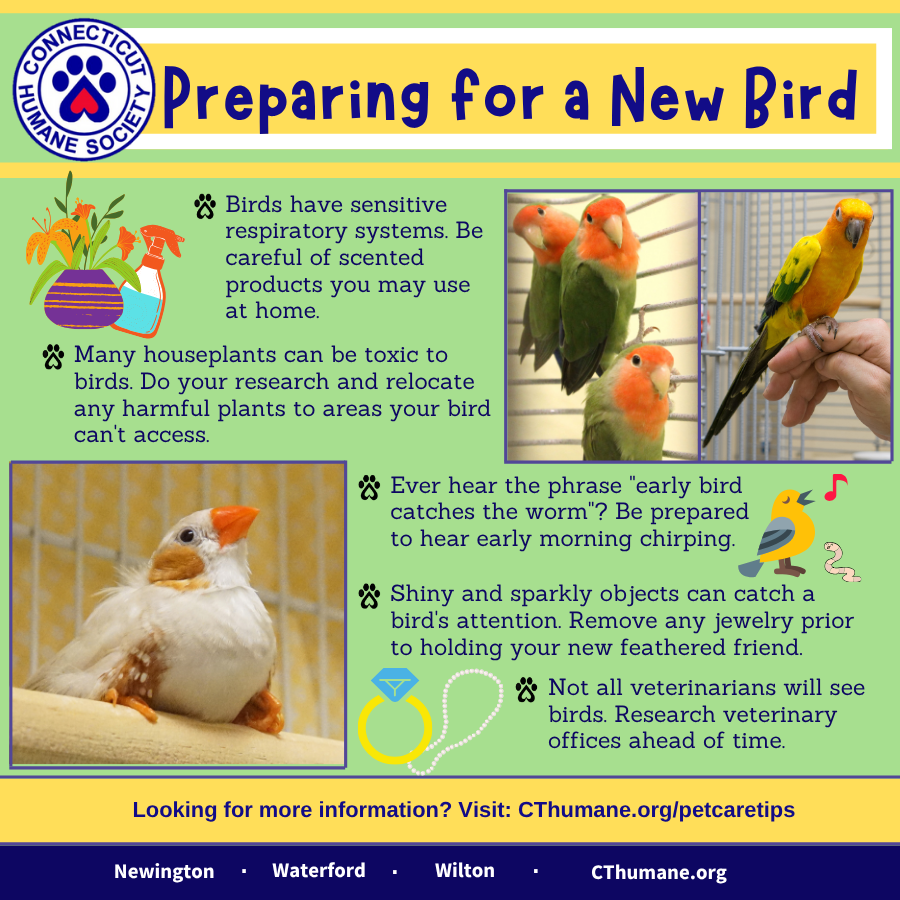
“What pet should I get?” It’s not just the title of a Dr. Suess book, it’s a question often heard from a first-time visitor to the Connecticut Humane Society. You’ve already thought about the pros and cons and whether or not you’re ready to get a pet, but you still might be on the fence about what type of pet you want. Or maybe you just adopted a pet, and you want to make sure you’ve covered all your bases. Check out these tips to start.
Birds are intelligent, beautiful and fun, but they are not the right pet for many families. With all that brain power, birds need a lot of attention, so they need a family with the time to commit to them every day. Plus, birds generally live a long time – parrots can live 50 years or more – so they need a family who is committed to them for the long-term.
Here’s a comparison of the types of birds that are most frequently seen at the Connecticut Humane Society. Always do your research – online, in print, and with veterinarians and avian experts, before adopting a bird!
| Species | Avg. Lifespan & Size | Housing | Diet |
|---|---|---|---|
| Cockatiel | 10-25 years 11" - 14" long | House alone or in pairs. Habitat for one cockatiel should be 18”W x 18”D x 24” H, with metal bars spaced no greater than ½” apart. | Specialized pellets should make up 60-70% of diet, along with fresh vegetables and fruits and small amounts of fortified seeds. Many cockatiels are used to a seed-heavy diet; transition gradually onto a pellet food. |
| Dove | 10-20 years 7 1/2 " - 12" long | House alone or in small groups. Habitat should be 24”W x 24”D x 24”H, with metal bars spaced no greater than 3/8” apart. | High quality, fortified seed mix should make up 60-70% of diet, along with fresh vegetables and fruits. |
| Finch | 5-10 years 3" - 8" long | Must be kept in pairs or preferably small groups. Habitat for up to three finches should be 24” W x 14” D x 18”H, with metal bars spaced no greater than 3/8” apart. | Specialized pellets should make up 60-70% of diet, along with fresh vegetables and fruits and small amounts of fortified seeds. Many finches are used to a seed-heavy diet; transition gradually onto a pellet food. |
| Lovebird | 15 years 5" - 7" long | House alone or in pairs. Habitat for 1-2 lovebirds should be 18”W x 18”D x 24”H, with metal bars spaced no greater than 3/8” apart. | Specialized pellets should make up 60-70% of diet, along with fresh vegetables and fruits and small amounts of fortified seeds. Many lovebirds are used to a seed-heavy diet; transition gradually onto a pellet food. |
| Parakeet (Budgie) | 7-15 years 7" long | House alone or in small groups. Habitat should be 18” W x 18”D x 18”H, with metal bars spaced no greater than ½” apart. | Specialized pellets should make up 60-70% of diet, along with fresh vegetables and fruits and small amounts of fortified seeds. Many parakeets are used to a seed-heavy diet; transition gradually onto a pellet food. |
| Small/Medium Parrot | 20+ years 10" - 13" long | House alone or in pairs. Habitat should be 30”W x 30”D x 36”H, with metal bars spaced no greater than ½” apart. | Specialized pellets should make up 60-70% of diet, along with fresh vegetables and fruits and small amounts of fortified seeds and nuts. |
Basic Information
- Different species of birds should not be housed together.
- Solo birds will require more human attention.
- If males and females are housed together, breeding or fighting may occur.
- Even if your new bird appears healthy, if there are other birds in the home your new bird(s) should be isolated from them for at least six weeks.
- Use bird-safe products only (cages, dishes, toys, cleaning products, etc.) Exposure to chemicals, fumes, or heavy metals (lead and zinc) can be deadly to birds.
- Always wash your hands after handling a bird or cleaning its dishes, cage, toys, etc.
Diet
- Fresh food and clean, filtered, chlorine-free water should always be available.
- Diets vary heavily between species. Do your research on your type of bird—their diet could require a diverse variety of pellets, seeds and fresh fruits and veggies.
- Vegetables and fruits not eaten within a few hours should be discarded.
- Do not feed birds avocado, fruit seeds, chocolate, caffeine or alcohol as these can cause serious medical conditions. Avoid sugar and high fat treats.
- To avoid contamination, do not place food or water containers directly under perches.
Housing
- Most birds acclimate well to average household temperatures, not above 80°F. Avoid extreme temperature changes.
- The habitat should be off the floor in a well-lit area, away from drafts.
- Do not place habitat in a window with lots of direct sunlight; birds can overheat.
- A flight habitat is strongly recommended. It is best to provide the largest habitat possible.
- A variety of perch sizes is recommended to provide exercise and prevent arthritis.
- Cover the cage at night to allow birds to sleep.
- Clean and disinfect the habitat and perches regularly; replace substrate or habitat liner weekly or more often as needed.
- Replace perches, dishes, and toys when worn or damaged; rotate new toys in regularly.
Training & Enrichment
- Enrichment for your bird includes regular out-of-cage periods, time with the family, toys, training and sometimes socializing with other birds (under supervision).
- Instead of putting food in a bowl, encourage a bird’s natural foraging behavior as much as possible through puzzles and enrichment items. Try putting a little food inside a rolled up paper bag or paper towel tube. Toys can be store bought or homemade—the possibilities are endless!
- Birds respond well to positive reinforcement training from their human companions. They can be taught the basics of clicker training and touch targeting.
Health & Veterinary Care
- Select a veterinarian that specializes in exotic birds and have them get to know you and your bird during regular wellness check-ups, before a health problem comes up!
- A healthy bird should be active, alert and sociable, eating and drinking often, sitting upright on a perch with feathers smooth.
- Sick birds will try to hide their illness and maintain a normal appearance, so be on the lookout for subtle changes.
- A bird that is inactive, sitting with feathers fluffed most of the time, or not eating may be sick. If you notice these signs, discharge from the eyes or nose, a change in color or appearance of the droppings, or other problems, please see your avian veterinarian right away.
- A bird that is head bobbing, pacing, spinning, rocking or swinging the head or body should be seen by a veterinarian.
- Avoid exposure to air pollutants (cigarette smoke, fumes from over-heated non-stick pans, etc.).
- Birds should be monitored at all times when let out of their habitat. Be aware of hazards such as toxic houseplants, open toilets, mirrors and ceiling fans.
- Your bird should be seen by an avian veterinarian at least once per year.
- Speak to your veterinarian about screening tests for viruses and parasites, blood testing and vaccines.
Check out the video below for kid-friendly bird care tips.
